

Lean Insight Organization
When does fast "good enough" insights trump slow precise ones?
Across multiple customer conversations, the most consistent request from (prospective) customers for our insight engine has been questions like these:
“How do I bring cancellations down from 5% to 1%?”
“How do I take lead conversions from 20% to 30%?”
“How can I bring losses to zero?”
“How do I maximise sales while limiting coupon burn to $ XX?”
“How do we bring down our transportation cost monthly?”
This has pushed us to fine-tune how our proactive insight engines fit into these companies' frameworks. It has also made us think about the type of insights and how speed and relevancy might matter.
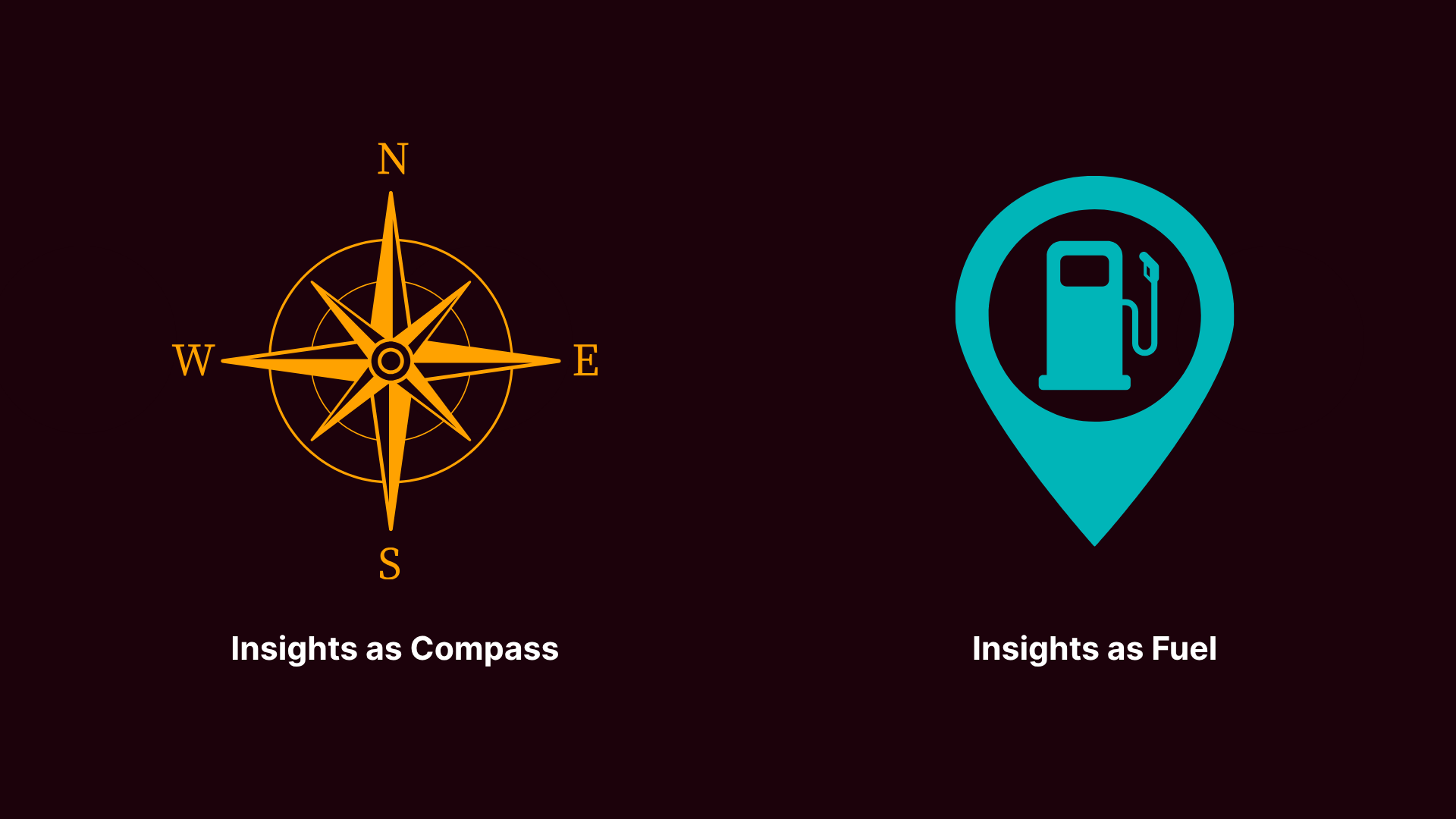
Insights as a compass
At the top level, every company has only two objectives:
Grow without spending too much more, or
Make more money with what you already do.
Everything else is a derivative of these two.
“In our category, becoming the lowest-unit-cost provider of delivered service will be our enduring competitive moat.”
An insight like this sets the direction.
This could be based on a business philosophy (“customer always wants cheaper prices”) or market reality (“we need to fix unit economics to survive”), or it could even come from a VC email.
This is insight as a compass. It helps frame the big objectives for a division or organization. It’s not as frequent, nor does it change quickly. But once the direction is set, the game of organization orchestration begins.
Insights as fuel
Progressing in the direction now requires dozens of smaller, constantly evolving insights.
“We need to reduce the cost of delivering each order,” would further bank on insights like:
There is a capacity arbitrage we are not using
There is time seasonality, which we are not optimized for
Our fleet routing is less than optimal
On and on. Tiny course corrections and metrics that add up to the larger direction. These are insights as fuel. These help move the ship in the direction that’s already set.
Companies need these insights day in and day out. This is what keeps managers awake at night and analysts churning over queries. However, it is also where there are high inefficiencies.
Fuel insights to action
“The only way to win is to learn faster than anyone else.”
― Eric Ries, The Lean Startup
The whole lean startup model changed how companies test digital products.
Quick iterations, MVPs, and incremental experiments have now been accepted as the best ways to learn and evolve in a constantly changing market.
However, business decisions outside of building digital products have not kept pace, mainly because learning and action loops are not as fast as in the digital world. In most companies, three bottlenecks slow down progress even once the direction is set:
The BI / Analytics Layer produces data, reports, dashboards, and hopefully helpful information.
The Insight Layer, often the “business person” who owns the metric, gleans actionable insights and decides actions.
The Action Layer is where decisions are implemented, and teams execute things.
Even with good people and good data, this pipeline can take weeks. We’ve talked many times (here, here) before about the elaborate orchestration of getting from data to insights. This is the not-so-proactive world of reviewing metrics, reports, and dashboards to know how things were.
The human who brings this together to derive insights on how to move a metric often lacks “bandwidth,” has contradictory goals, and is slowed down by mundane operational tasks. This layer demands fuel insights that can quickly enable the business person to move towards their goals.
Of course, the third limiting factor is operationalizing this with a technology team, a factory floor, a logistics division, etc. This has its own orchestration, communication, development, and deployment rhythm.
These bottlenecks slow both the fuel (insight) and the actual burning of the fuel (action). On top of this, companies tend to seek unnecessary levels of precision on insights.
Speed vs. Precision
Even the most data-centric companies (are they the worst offenders?) tend to fetishize precision to an unnatural degree. There is a lot of back-and-forth and debate around the quality of the insights. Business managers keep churning on their “insight” because it will be probed, and false insights mean organizational status loss.
Business managers keep churning on their “insight” because it will be probed, and false insights mean organizational status loss.
But fuel insights are more effective if they are fast, continuous, and relevant in the moment. One study found that in chess (over 80,000 moves), faster decisions were consistently associated with better choices. In a high-velocity environment, waiting for 95% confidence is missing favorable winds while waiting for a perfect weather forecast to sail.
Even companies with celebrated decision-making thumb rules (like ‘bias for action’) seem to need reminders on speed. Andy Jassy had this to share this year internally at Amazon:.
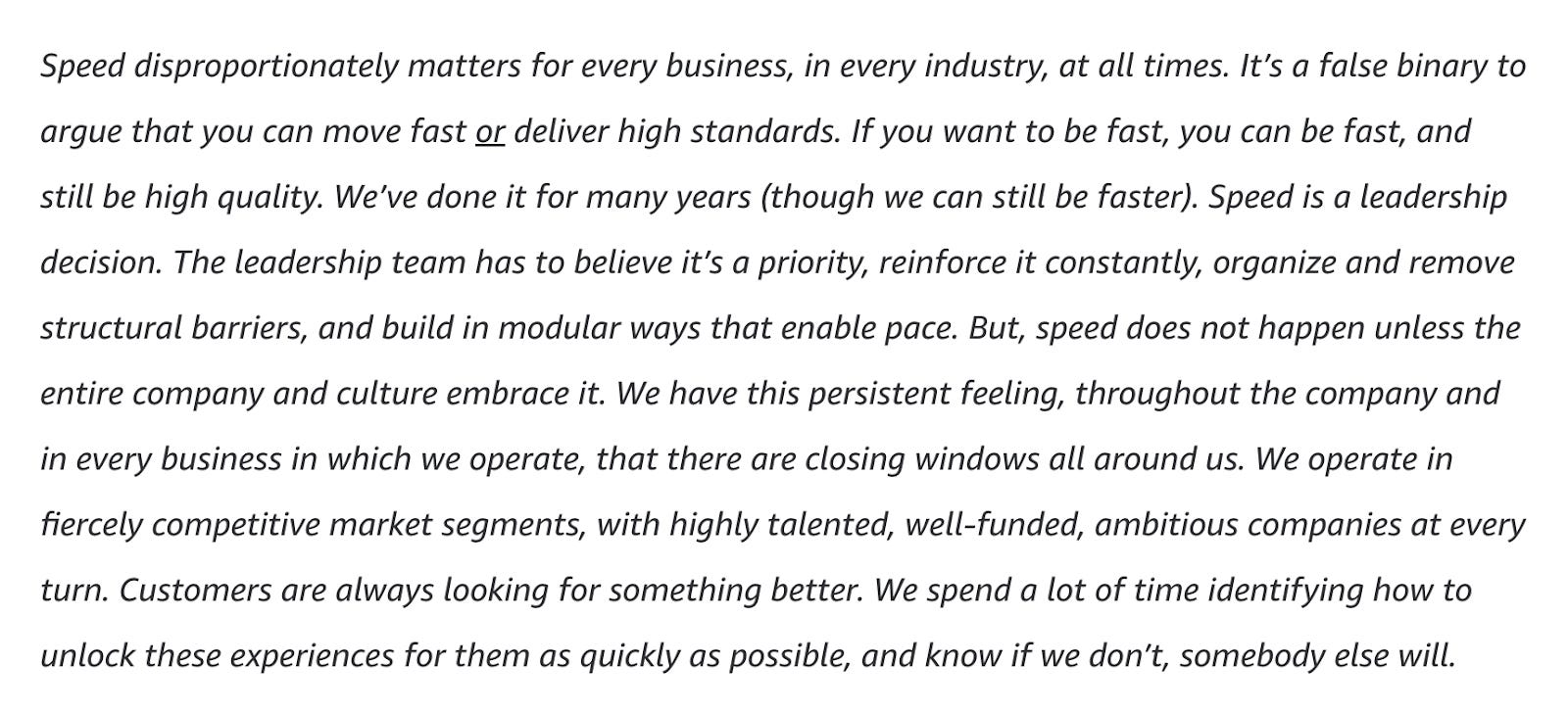
Seeking extreme precision on insights comes with a massive cost to speed. While one company gathers insights over a quarter, another runs experiments daily. The value deflates with every passing moment because the conditions that created those insights change dynamically.
Traditional BI has focused on compressing time to information. With AI and insight engines, we are perhaps moving to an era of compressing time to insight.
Traditional BI has focused on compressing time to information. With AI and insight engines, we are perhaps moving to an era of compressing time to insight.
Continuous insights transform organizational rhythms.
Time to action is the real measure businesses should care about. How long does it take to go from data, insight, decision, and action that enables the business to improve its position?
Today, these are fragmented steps without a single measure of effectiveness.
Take an example of a large vehicle manufacturer with 800+ dealerships nationwide. Every day, thousands of data points on test drives, financing requests, stock levels, regional campaigns, and customer footfall that have a real impact on the business are collected.
The customer could walk out if a trending model isn’t available for a test drive.
If one region’s financing approvals slow down, lead conversion drops.
Sales velocity will plummet if one dealer hoards inventory while another runs dry.
Ordinarily, this would be managed through daily/weekly reports, the chain of command of regional managers, monthly divisional reviews, and so on. In the best-case scenario, course corrections and fixes happen over weeks, with an enormous opportunity cost.
On the other hand, a proactive insight engine should ideally drop in insights that can become decisions:
Showroom A’s test drives for the SUV variant dropped 30% week-on-week. Possible cause: local campaign fatigue or competitor launch. Trigger a quick weekend test-drive event or ad refresh to recover footfall.
This shrinks opportunity cost enormously and opens up new possibilities by enabling faster interventions.
Insight engines and eventually AI agents that can execute proactively made decisions can bring the lean startup approach to running business metrics.
If every business owner could get continuous, proactive insights on how to move the needle for their metric, these changes would start compounding. Business reviews and course corrections become continuous. Instead of debating what happened, leaders discuss what to do next.
At scale, this changes the rhythm of the entire organization.
~Babbage Insight